
By Alan Batchelor, Founder of YooDrive
Our industry has accepted another weak idea as normal.
We have accepted message threads as if they were booking systems.
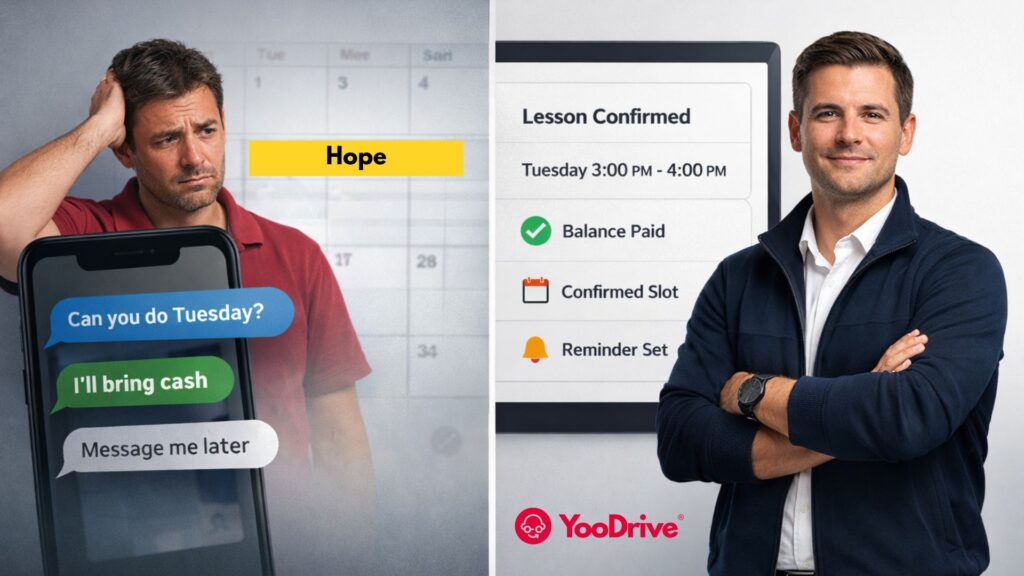
We have accepted “I’ll bring cash” as a commitment.
We have accepted “Can you do Tuesday?” as a proper agreement.
We have accepted verbal promises as if they carried the same weight as a real booking.
They do not.
A serious instructor is not running a hobby.
A serious instructor is not reserving professional time for the sake of hope.
A serious instructor should not be operating in systems where the pupil can commit later, argue later, cancel later, or disappear later — while the instructor carries the cost first.
That is not a strong normal.
It is a weak one.
Our industry has tolerated loose bookings for too long
Driving instructors plan their days.
They reserve the slot.
They structure their diary.
They turn away other work.
They prepare for the lesson.
They show up ready.
That time has value.
So here is the question:
If an instructor’s time has real value, why are lesson slots still being held without proper commitment in place?
That question matters because it exposes something our industry has tried to live with for too long:
the loose booking culture.
The loose booking culture sounds harmless at first.
It sounds like:
- “Message me when you know”
- “I’ll confirm later”
- “I’ll bring it with me”
- “Can we just move it?”
- “I thought that was for next week”
But beneath the politeness is a broken structure.
Because when the booking is weak, the instructor is the one left exposed.
Many instructors have worked this way because it became normal, not because it was ever really that strong.
Off-platform, the pupil often has the upper hand
This is what too many instructors already know, but have been expected to accept.
Off-platform, the pupil often has the upper hand.
They can:
- delay payment
- cancel late
- change the story
- dispute what was agreed
- disappear altogether
And when that happens, the instructor usually carries the cost first.
Not the pupil.
The instructor loses:
- the slot
- the income
- the time
- the opportunity to fill it
- the confidence that the diary is truly under control
That is not just annoying.
That is a structural weakness.
A weak structure should not be accepted as normal by a serious profession.
“I’ll bring cash” is not a commitment. It is a hope with a travel plan.
Hope is not a booking system
This is the point our industry needs to face.
Hope is not a booking system.
A message thread is not a booking system.
A verbal promise is not a booking system.
A vague “I’ll sort it” is not a booking system.
These things can work sometimes.
That is not the same as saying they are strong.
Plenty of weak systems survive for years simply because people get used to tolerating them.
That does not make them good.
It just makes them familiar.
And what is familiar is not always what deserves to survive.
A real booking should do more than reserve time
A real booking should create:
- commitment
- clarity
- proof
- terms
- accountability
A real booking should not leave the instructor guessing whether the lesson is truly secured.
That is the difference between a loose arrangement and a proper system.
A proper system says:
- This slot is committed
- The terms are clear
- The booking exists
- The structure is real
That is what a professional booking culture looks like.
Why a verified booking matters
This is where the conversation becomes simple.
A verbal promise is not a verified booking.
A verified booking has weight because it leaves a trail.
It shows:
- A real slot was held
- A real arrangement was made
- real commitment existed
- The lesson was not just “talked about”
That matters more than people think.
Because once a booking is properly structured, everything around it gets stronger:
- payment discipline
- cancellation clarity
- reminders
- reputation
- trust
A weak booking weakens the whole system around it.
A strong booking strengthens the whole system around it.
The better standard: No balance. No booking.
Our industry needs a stronger normal.
The better standard is simple:
No balance. No booking.
That means the pupil credits their balance first.
Then the instructor creates the booking.
That is not harsh.
That is not anti-pupil.
That is not distrust for the sake of it.
It is professionalism.
It says:
- Serious time deserves serious commitment
- A lesson slot should not be held on hope
- Structure should come before assumption
- Commitment should come before protection is expected
This protects both sides, but it especially stops the instructor from carrying all the weaknesses of the old system.
This is not about becoming rigid
Some people hear a stronger structure and assume it means becoming cold, rigid, or difficult.
It does not.
A professional booking system is not about being unfriendly.
It is about being clear.
Clear systems create fewer awkward conversations, not more.
They create better expectations, not worse.
They reduce uncertainty; they do not increase it.
And most importantly, they stop the instructor from being the only person expected to absorb the looseness of the arrangement.
What our industry has accepted as normal is not good enough anymore
This is the real point.
Our industry has accepted too much under the name of normal:
- loose promises
- unclear payment expectations
- weak commitment
- late cancellations with weak boundaries
- message-thread “bookings”
That is not the kind of structure a serious profession should be relying on.
Driving instructors are trusted professionals.
They are not placeholders in somebody else’s casual plan.
They are not expected to protect a pupil’s schedule while the pupil leaves the commitment undefined.
That old normal is weak.
And weak systems should not be defended just because they are familiar.
Why YooDrive matters here
YooDrive does not stand between instructors and their pupils.
It gives structure to the booking.
That means:
- The pupil credits their balance first
- The instructor creates the booking
- The booking becomes verified
- The terms become clearer
- The lesson is supported by reminders and proper structure
- The instructor’s time is better protected
That is not “another layer.”
That is the system finally doing the job it should have been doing all along.
And importantly:
- The instructor sets their own rate
- The instructor keeps their own rate
- YooDrive does not take a percentage of the lesson price set
The point is not to control the instructor.
The point is to strengthen the booking.
Final thought
A weak promise is not a strong booking.
A verbal yes is not the same as a verified commitment.
A message thread is not a proper operating system.
And hope is not a serious way to protect professional time.
Our industry has accepted this for too long.
It does not have to anymore.
A verbal promise is not a verified booking.
That is not just a phrase.
It is the beginning of a better booking culture for our industry.
By Alan Batchelor, Founder of YooDrive