By Alan Batchelor, Founder of YooDrive
Our industry cannot protect the public properly if trust only becomes visible at the passenger door.
That is the old normal.
A learner meets the instructor.
They look for the badge in the windscreen.
They decide, often too late, whether this feels professional, safe, and legitimate.
But in a digital world, that is no longer good enough.
Trust should begin before the first lesson.
Because the first lesson is not the first moment that matters.
The search matters.
The profile matters.
The booking matters.
The decision to get into the car matters.
And if our industry is serious about public protection, then professionalism should not become visible only when the learner reaches the vehicle. It should be visible before the booking is ever made. DVSA itself says paid driving instruction is a regulated profession in Great Britain and that ADIs must meet legal requirements, satisfy the Registrar that they are fit and proper, and undergo a criminal records check.
This is not about alarmism. It is about recognising that positions of trust deserve stronger signals earlier.
The old normal is too late
For too long, our industry has behaved as if trust can wait.
Wait until the first meeting.
Wait until the car arrives.
Wait until the badge is seen.
Wait until the lesson begins.
That is too late.
Because by then the learner has already:
- searched
- guessed
- compared
- messaged
- committed
- and decided who felt legitimate enough to contact
If that early stage is still dominated by noise, weak signals, and guesswork, then our industry is leaving the public to navigate trust with too little clarity.
That should trouble us.
The badge still matters. But in a digital world, waiting until the car door to discover trust is a little late.
This is not a theoretical problem
This matters because there have been real safeguarding concerns in driver training.
DVSA has publicly described sexually inappropriate behaviour by driving instructors as unacceptable and said it strengthened safeguards to protect learner drivers. It also points learners to official ways to identify approved instructors and notes that instructors listed there have passed enhanced criminal record checks and had their ability to teach assessed to a set standard.
Campaigners have pushed this further. FearFree’s Emergency Stop campaign argues that driving instructors should be treated as positions of trust because of the vulnerability that can exist in one-to-one tuition.
That does not mean our industry should descend into hysteria.
It means our industry should grow up.
If trust matters enough to be checked in law, then it matters enough to be visible in practice.
The badge should not only sit in the windscreen
This is the principle.
The DVSA badge should not only sit in the windscreen.
It should be visible online too.
Not as decoration.
As a signal.
A signal that says:
- This person belongs to a regulated profession
- This person should be easier to identify as legitimate
- This person should be easier for the public to distinguish from noise, imitation, and confusion
Because the public should not have to wait until the car door to know who is genuine.
That is not a modern standard.
It is a delayed one.
And delayed trust is weaker trust.
Our industry has accepted weak digital signals for too long
Here is the bigger problem.
Online, learners often see:
- profile pictures
- comments
- posts
- claims
- messages
- impressions
But impressions are not standards.
And visibility is not trust.
A serious instructor can be flattened into the same digital space as somebody far less credible simply because the internet rewards noise quickly and trust slowly.
That is bad for learners.
Bad for parents.
And bad for good instructors.
Our industry should not make the public do detective work just to separate the genuine from the questionable.
Regulation exists. Visibility should follow it
This is where the argument becomes simple.
If paid driving instruction is regulated, then visible trust should support that regulation, not lag behind it. GOV.The UK’s guidance for finding a driving instructor highlights approved instructors and states that those listed have passed enhanced criminal record checks and met a set teaching standard.
In other words, the principle already exists:
The public benefits when legitimate instructors are easier to identify.
So the question is not whether visible trust matters.
The question is why our industry has been so willing to leave that trust half-hidden online.
A digital world needs a digital expression of professionalism
The world changed.
People search first.
Compare first.
Message first.
Book first.
So the industry standard has to change too.
Professionalism should not live only:
- On a badge in a car
- In a private recommendation
- In a conversation after the fact
It should live:
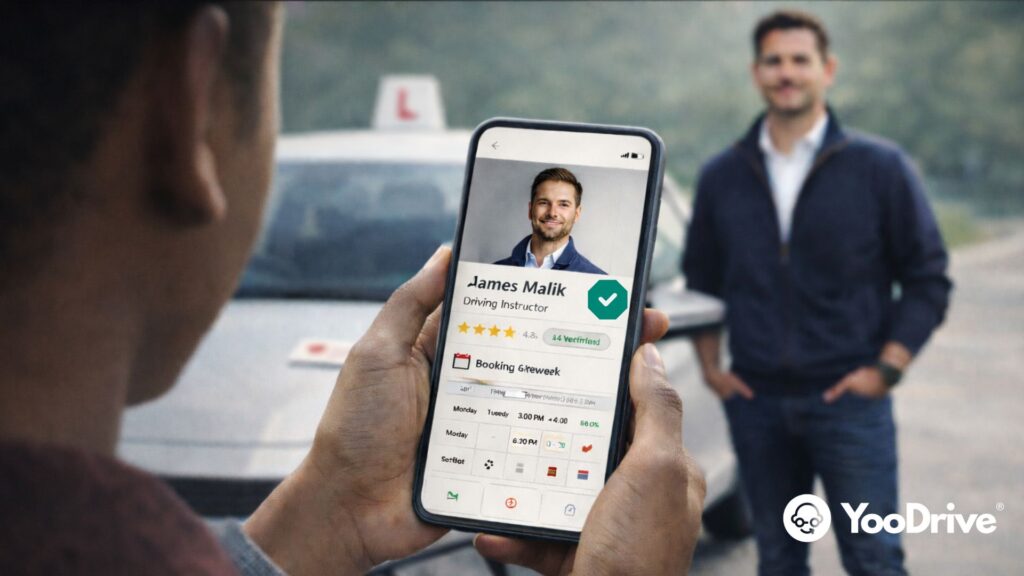
- On the profile
- In the booking trail
- In the visible reviews
- In the proof attached to real lessons
That is what modern trust looks like.
Not because the badge is unimportant.
Because the badge should no longer be the first time trust becomes visible.
Why this matters for good instructors
Good instructors should want this standard.
Why?
Because visible trust protects the public and rewards seriousness.
It helps serious instructors stand apart from:
- fake instructors
- weak operators
- online attention seekers
- people who can manufacture visibility but not real proof
This is not about making honest instructors jump through more hoops.
It is about making the standard they already meet more visible before a learner ever gets into the car.
That is better for everyone.
Why YooDrive matters here
YooDrive was built to help promote great instructors and give every instructor an online operating system.
That includes:
- a profile you own and operate
- visible reviews
- searchable trust
- clearer booking structure
- signals that help the public distinguish real professionalism earlier
YooDrive is not a replacement for regulation.
It is the online expression of a standard our industry should already want the public to see.
Because trust should not begin only when someone notices the badge in the windscreen.
It should begin before the booking.
Before the message.
Before the lesson.
Final thought
Our industry cannot keep acting as if trust starts at the car.
That is too late.
Too weak.
Too outdated.
In a digital world, trust should begin earlier.
It should be easier to see who is genuine.
Easier to verify who is a professional.
Easier for parents and learners to distinguish a real instructor from online noise.
The badge still matters.
But the badge should not only sit in the windscreen.
It should be visible online too.
That is not just better marketing.
It is a better standard of protection for the public.
By Alan Batchelor, Founder of YooDrive